
For doctors
A patient may hand you a page from Kairix. Here is what it shows, and how each number is counted.
Kairix is an app for people with chronic migraine and chronic pain. It keeps their medicines, doses, migraine logs and a short evening check-in on their phone. The reports are built from those entries. Kairix reports facts: it makes no diagnosis and gives no advice.
The reports
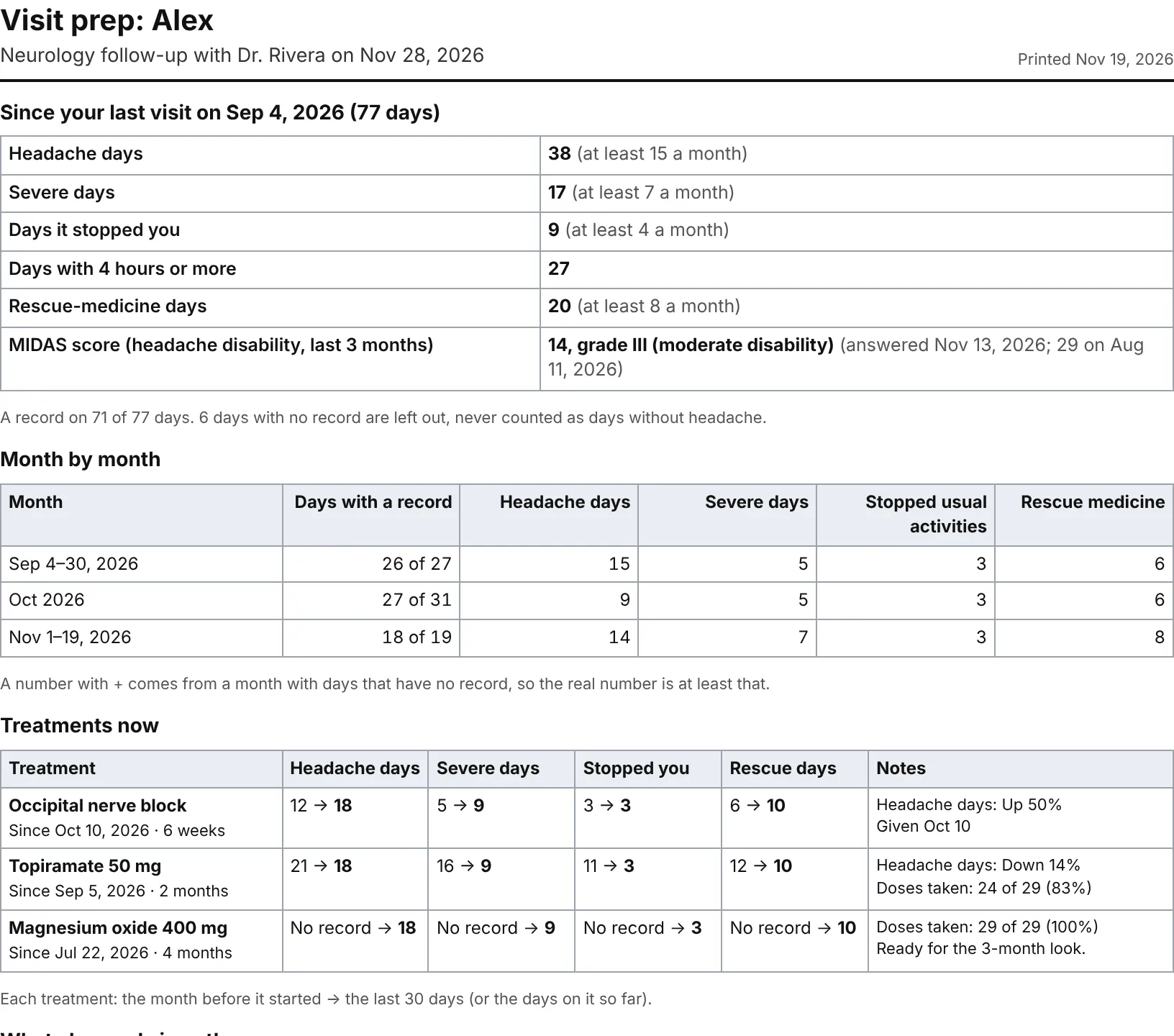
- Visit prep: one page since the last visit. Headache, severe and rescue-medicine days, month by month; each treatment before and after; what changed; rescue medicine by class against its limits; the MIDAS score; and the patient’s questions.
- The 30-day report: every medicine taken, day by day and by part of the day, with headache days alongside. Daily medicines against what was due, as-needed ones, and rescue medicines, each marked. Also for 7 or 90 days.
- Headache record for a disability claim: 3, 6 or 12 months. A summary, month by month, weeks with a headache day, a typical attack, treatments tried, doses taken and visits.
- Report for an insurer: the last 6 months, for a prior authorization or a renewal. Headache days a month and how many lasted 4 hours or more, rescue-medicine days, and each kind of preventive tried and for how long.
- Also: the pain record, and the medicine list, now and before.
How each number is counted
- A day with a record
- A day with an evening check-in or a headache logged in Kairix. A day with no record is left blank. It is never counted as a day without headache.
- Headache day
- A day with a record whose worst answer is mild, moderate or severe.
- Severe day
- “Severe” in the check-in, or 7 to 10 on the migraine log’s 0 to 10 pain scale. 4 to 6 counts as moderate, and 1 to 3 as mild. When the check-in and a log differ, the worse one counts.
- A day it stopped them
- “I could not do my usual things,” in the check-in or in a migraine log.
- 4 hours or more
- Hours from the check-in, or from logged migraines that have an end time.
- Rescue-medicine day
- A day with any dose of a rescue medicine marked taken, whether or not the day has a check-in.
- A number with +
- From a stretch where fewer than 24 of 30 days have a record. The real number is at least that.
- A change (“Down 19%”)
- Worked out only when both stretches have a record on at least 24 of their 30 days.
- Before and after a treatment
- The month before it started, next to the last 30 days. Kairix says when the usual look is due: about 3 months for pills and monthly shots, about 6 months (two cycles) for Botox and other treatments given every 3 months.
- Kinds of preventive tried
- Grouped the way insurers ask, such as CGRP antibodies, gepants, Botox and seizure medicines, with the dose, how long and why it stopped. The insurer report counts a fair trial as 60 days or more.
- Medication-overuse counts
- Days with any use, not doses, against the ICHD-3 thresholds: 10 or more days a month for triptans, ergots, opioids, combination analgesics or any mix of classes, and 15 or more for simple analgesics. Kairix shows the counts. It never says a patient has medication-overuse headache.
- MIDAS
- The five-question Migraine Disability Assessment, answered every 3 months, with its grade.
What to keep in mind
- It’s the patient’s own record. Kairix counts what they entered and doesn’t check it. Gaps are shown, never filled in.
- It stays on their phone. There is no account and no server. Kairix can’t see the records; the patient chooses to print or share a page.
- The medical wording is in draft. The warnings, label limits and drug class lists are waiting for review by a pharmacist and a neurologist. Interaction checks cover a short list of high-priority pairs only.
Questions or corrections?
Clinicians’ notes on the wording, the counts or the reports are very welcome: support@kairixapp.com.